MaviS
Materials research and virtual sensor concepts as drivers of innovation for SOECs
In the project MaviS, Montanuniversitaet Leoben, AVL List GmbH and Materials Center Leoben Forschung GmbH are working together on a new approach to improve long-term stability and reduce development time and cost of solid oxide electrolysis cells (SOECs).



This project is funded by the Austrian Research Promotion Agency (FFG) / Klima- und Energiefonds within the Call Energieforschung 2024 FTI -Fokusinitiativen, project number: FO999926836
Project Title
- MaviS - Materials research and virtual sensor concepts as drivers of innovation for solid oxide electrolysis cells
Duration
- 01.06.2026 - 31.05.2029
Partners
- Montanuniversitaet Leoben, Chair of Physical Chemistry (Consortium Leader)
- AVL List GmbH (Project Partner)
- Materials Center Leoben Forschung GmbH (Project Partner)
Funding / Call
Contact
Assoz.Prof. DI Dr. Edith Bucher
Chair of Physical Chemistry
Montanuniversitaet Leoben
Email: edith.bucher(at)unileoben.ac.at
Dipl.-Ing. Johannes Lackner, BSc
Technology Scout Fuel Cell
AVL List GmbH (AVL)
Email: johannes.lackner(at)avl.com
Priv.-Doz. Dr. Roland Brunner
Group Leader Material and damage analytics
Department Microelectronics
Materials Center Leoben Research GmbH (MCL)
Email: Roland.Brunner(at)mcl.at
Improving the long-term stability of solid oxide electrolysis cells (SOECs), combined with reducing development time and cost, is one of the most important and challenging requirements for the development of market-ready cells, stacks and systems. A particularly critical aging mechanism in SOECs is the change in the morphology of the cathode over time, especially the coarsening of the nickel phase, which reduces the electrochemically active area and increases the electrical resistance. This impairs performance and can lead to cell failure in the long term.
To investigate these mechanisms, detailed in-situ insights into the ongoing changes in 3D morphology and their direct effects on electrochemical properties would be necessary. However, due to limited measurement capabilities and high costs, such analyses are difficult to perform. Electrochemical methods such as impedance spectroscopy (EIS) and current-density-voltage (i-V) curves can only monitor the cells to a limited extent, but do not provide in-situ insights into the exact degradation mechanisms.
In the project, fuel electrodes with systematic variations are manufactured and applied to commercial half cells. Electrochemical tests using complementary methods such as EIS, i-V curves, Total Harmonic Distortion Analysis (THDA) and Intermodulation Distortion Analysis (IMA) determine characteristic signatures for specific damage mechanisms. Post-mortem analyses link these signatures to changes in morphology parameters. An AI-supported image characterization workflow enables the reduction of experimental effort and thus a more time- and cost-efficient post-mortem analysis. Virtual 3D reconstructions of morphology and data-driven modeling improve the understanding of degradation mechanisms. Generative AI is used to model the morphology changes. The coupling of data-driven and physical modeling provides a better understanding of cell degradation. Furthermore, this hybrid approach improves the significance of the influence of morphology changes on the lifespan of the cells.
The methodology developed can be used in a future virtual sensor concept. This is to be understood as an online diagnostic tool developed beyond the project, which can draw conclusions about the type and stage of the degradation mechanisms by in-situ monitoring of various sensor signals of the cells, stacks or systems.
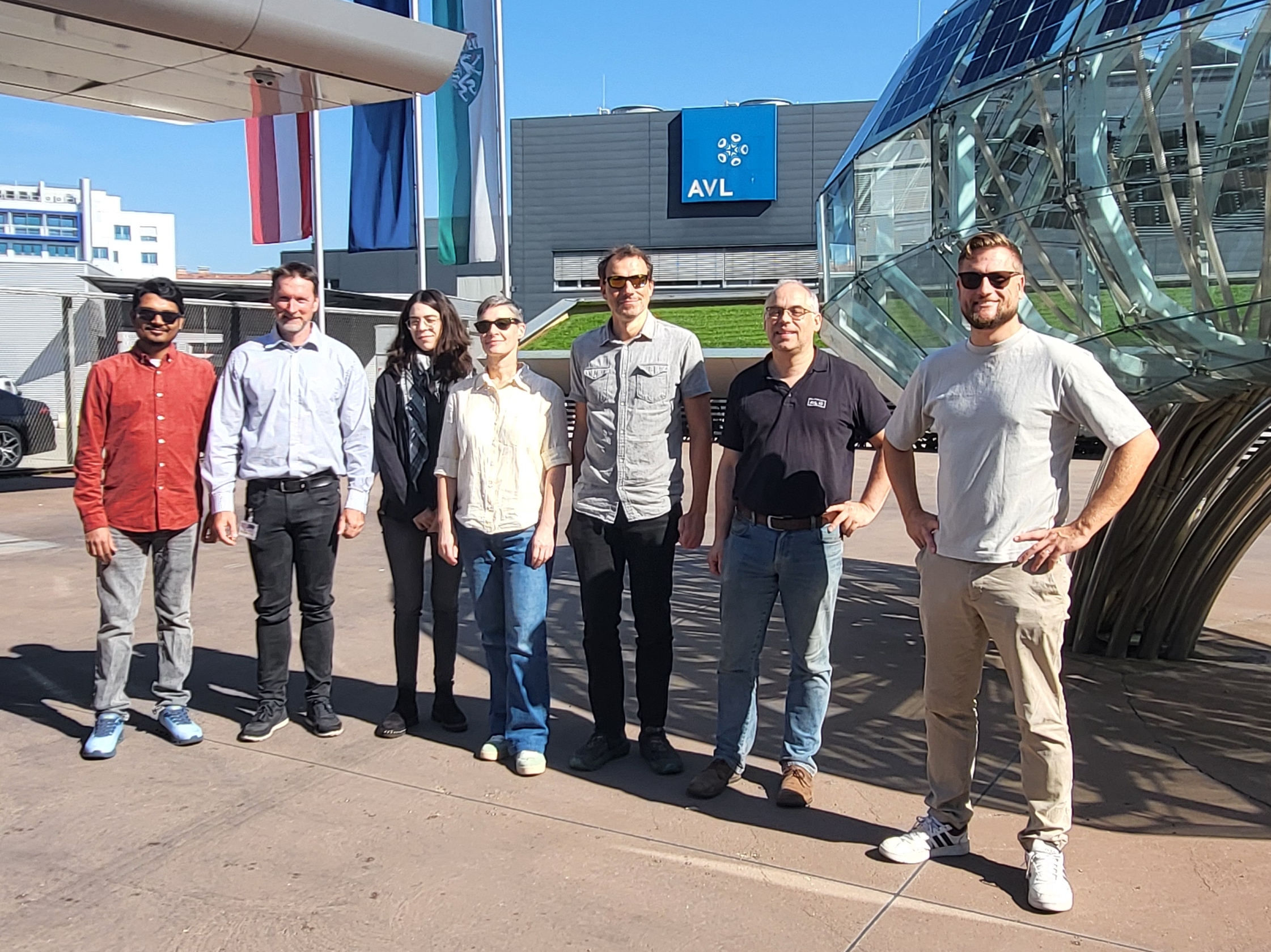
MaviS consortium at the kick-off meeting, (c) AVL / J. Lackner